



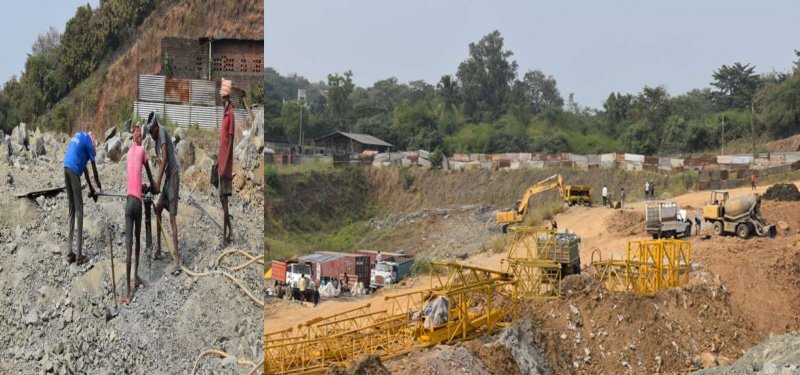
Rock Excavation By Control Blasting Method
Technical Report & Proposed Blast Design
Controlled blasting is a technique of blasting, which is used to reduce the amount of over break and to control ground vibrations. The different types of controlled blasting techniques are pre-splitting, smooth blasting, line drilling, perimeter blasting, and cushion blasting.
1.00: Blast Monitoring:
1.10: Maximum Explosive Charge per Instant Or per detonation has been tabulated: For PPV 4.00 mmps.
2.00: Proposed Blast Design:
We have limitations as regards to the maximum explosive charge to be used per instant. So in order to get the optimum production rate with we have to depend upon the initiations systems to be used and the special Controlled blasting methods to be incorporated to reduce the blast induced ground vibrations.
2.10: Initiation systems that can be used:
We have limitations as regards to the maximum explosive charge to be used per instant. So in order to get the optimum production rate with we have to depend upon the initiations systems to be used and the special Controlled blasting methods to be incorporated to reduce the blast induced ground vibrations.
2.10: Initiation systems that can be used:
Instantaneous Electric Detonators.
Electric Millisecond Delay Detonators
Shock Tube System of initiation.
2.11: Of the three methods above the Instantaneous Electric Detonators will offer minimum production with large size boulders and maximum vibrations. As a matter of fact this is being presently used as cost wise it is the cheapest.
2.12: The Electric Millisecond Delay detonators though slightly expensive, can offer us better production rate smaller size boulders and less vibrations as compared to the previous one. Electric delays are available in 10 # & each one is numbered as 1,2,3…up to 10 no.. There are 25millisecond delays installed. Number 1 delay will detonate 25 millisecond after no. “0”, no. 2 will detonate 25 millisecond after no. “1” & so on. All the delays will detonate within 250 millisecond. So total explosive charge in all the blast holes can be safely divided in to 11 parts. One part (delay) detonating at one time. This will reduce the vibrations as explosive is divided. So with this system instead of 10 # blast holes we can blast 22 holes per blast & that too with more depth & increased explosive charge per hole offering increased production.
2.13: The Shock Tube system, though expensive, will able to give us maximum production with smaller size boulders and low vibrations values. Hence, it is the best for optimum production. This is the most modern system in which we can control the sequence of blasting with more accurate timing. Here we can blast each of the blast hole at totally independent or different timing. This is one of the major advantages of this initiation system as we can practically blast each hole at different timings and thereby load the blast hole at maximum capacity mentioned in the tabular form. This, no doubt, increases the production than previous two methods.
2.20: Special Methods Of Controlled Blasting To Be Incorporated:
Following are the two methods that can be used.
Line Drilling and / or Presplitting
Air Column Method.
2.21: Line Drilling has already being done all round the periphery of the blasting area which can help in reducing intensity of transverse vector component of the blast induced ground vibrations.
2.22: Air Column Method:
Air Column method for nullifying vertical vector component of Peak Particle Velocity & finally reducing Peak Particle Velocity Value of the true vector sum. Kindly refer figure no: 1. This method consists of leaving an air column at the bottom of the of the explosive charge. The spacing used for leaving this air column can be a piece of hard PVC pipe having diameter 25mm & length of 75mm. By creation of air column at the bottom of the explosive charge there is convenient change in the media of travel for the vertical vector component of the blast induced ground vibrations. This change in media of travel in turn change status of the vertical vector from compressive wave in to tensile wave form and hence no vibrations are transmitted to the bottom of the blast hole. Further, due to this air column the centre of gravity of whole explosive column is raised providing more strength to the transverse & radial vector components by raising their level. This results in better fragmentation.
3.00: Blast Design:
3.10: Drilling Parameters:
Diameter & depth of the blast holes: 32mm & 2.00 mtrs.
Drilling Geometry: Holes are to be drilled vertical in 0.5 mtrs grid pattern.
Spacing & Burden Values: Spacing 1.00 mtrs & Burden 0.5 meters.
Production Per Blast Hole: 1 cubic meters insitution.
3.11: Number of blast holes per blast using millisecond electric delay detonators: 11#.
Production Per Blast: 11 cubic meters.
Number of blasts per day: Five #. (within one hour).
Total production per day: 55 cubic meters.
3.12: Number of blast holes per blast using shock tube system: 50#
Production per blast: 50 cubic meters. Number of Blasts per day: 5 # .
Total production per day: 250 cubic meters per day.
3.20: Blasting Parameters:
Each of the blast holes in both the system is to be charged with 250 gms of explosives. Air column method can be incorporated as explained earlier along with the already existing line drilling.